SpaceX Starship caught by launchpad arms after first orbital flight
The upper-stage spacecraft completed 14 orbits before descending over Texas and being caught by mechanical arms, a key step toward full reusability.
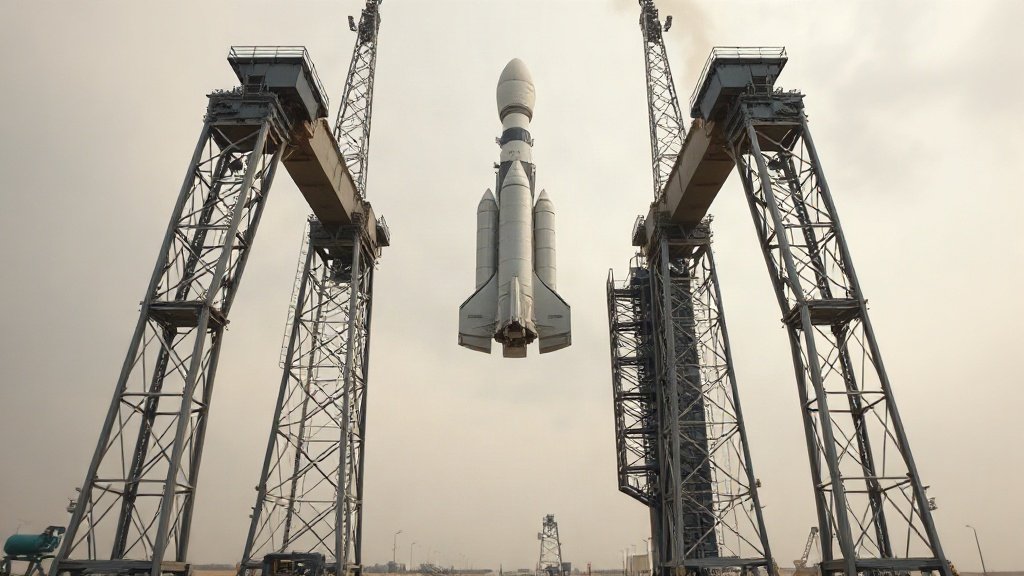
Illustration: AI-generated image
SpaceX’s Starship spacecraft returned to Earth on Saturday and was caught mid-air by giant mechanical arms at the company’s Starbase facility in Texas, marking the first time a Starship flying back from space has been captured in this way.
The upper-stage vehicle descended through cloudy skies and slipped between the mechanical arms known as chopsticks above Launch Pad 2, completing a journey that began 22 hours earlier with liftoff from the same site. The mission saw Starship complete 14 laps around the Earth at an altitude of about 265 kilometres, far exceeding the one or two orbits achieved on its previous flight.
SpaceX officials said the capture demonstrates the spacecraft’s full reusability, which is essential for rapid and low-cost recycling of the vehicle. The flight was the 15th full-scale Starship test since 2023 and only its second trip to orbit. NASA, which is paying billions of dollars for Starship to land Artemis astronauts on the Moon later this decade, welcomed the achievement. “It was almost magic,” NASA Administrator Jared Isaacman wrote on X.
However, the mission fell short of a desired double catch because the first-stage booster exploded shortly after Friday’s liftoff. SpaceX’s Kate Tice said the booster’s engines stopped firing too soon during its descent. The guidance system detected it was not in the correct position and automatically ordered a self-destruction manoeuvre into the sea. Engineers are still investigating the cause. SpaceX had previously caught boosters three times, so the technique itself is proven.
Despite the booster loss, the upper-stage spacecraft performed well. SpaceX reported that all systems, including the vital heat shield, appeared to work as intended. After separating from the booster, the spacecraft deployed 26 advanced Starlink satellites into orbit. Starship is the world’s largest and most powerful rocket, standing 124 metres tall and designed for future Moon and Mars travel. SpaceX expects to begin launching Starships from Florida’s Kennedy Space Center within the next few months.