Pakistani astronaut makes history on Tiangong station
Muhammad Zeeshan Ali becomes first foreign astronaut in China's crewed programme, lifting off for a week-long mission with scientific experiments.
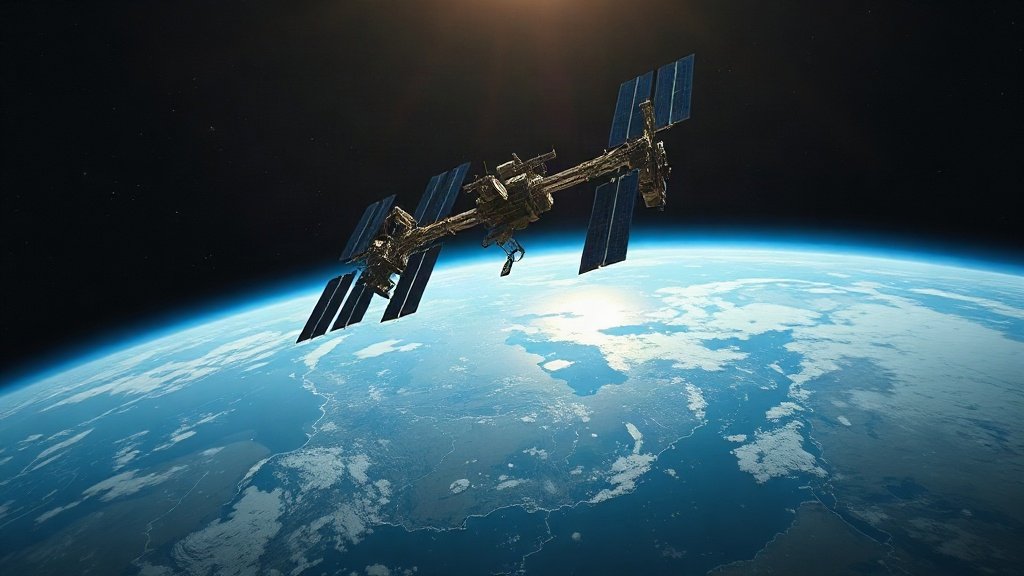
Illustration: AI-generated image
Pakistan has marked a new chapter in space exploration as Muhammad Zeeshan Ali became the first foreign astronaut to join China’s crewed space programme. The Pakistan Air Force pilot lifted off on Wednesday aboard China’s Shenzhou-24 spacecraft, heading for the Tiangong space station.
Ali is flying alongside Chinese commander Tang Hongbo and flight engineer Wu Yi. He is expected to spend about a week on the station, carrying out scientific projects in biotechnology and materials science before returning to Earth on the Shenzhou-23 spacecraft.
The mission cements a partnership that has been years in the making. China and Pakistan have long cooperated on space technology: Beijing has launched satellites on behalf of Islamabad, and Pakistan’s space programme, which dates to the 1960s, has focused on satellite development, communications and remote sensing.
A milestone for China-Pakistan cooperation
The joint crewed flight was first conceived in 2019, according to Pakistan’s Dawn newspaper. In February 2025, the China Manned Space Agency and Pakistan’s Space and Upper Atmosphere Research Commission formally agreed to cooperate on selecting and training Pakistani astronauts. Ali was chosen from that process.
At a pre-flight press conference, Ali said the friendship between China and Pakistan is “as vast as outer space”. Beijing and Islamabad describe their ties as an “ironclad friendship”, and Pakistan is a key partner in China’s Belt and Road Initiative.
Why it resonates in the Gulf
For the Gulf states, the mission carries particular interest. Large Pakistani communities live across the UAE, Saudi Arabia, Qatar, Kuwait, Bahrain and Oman, and many will be following the flight with pride. The region is also investing heavily in its own space ambitions – the UAE and Saudi Arabia both have active astronaut programmes – so China’s deepening role as a space partner is being watched closely.
So far, 27 Chinese astronauts from 11 crews have visited the Tiangong station. Ali’s flight opens a new phase of international participation in China’s orbital laboratory, and his experiments could add to knowledge in areas ranging from new materials to biological processes in microgravity.
The mission is expected to last about a week, after which Ali will return aboard Shenzhou-23, which remains docked at the station. For Pakistan, it is a proud moment that places the country among a small group of nations with citizens who have flown in space.