Nabati Poetry: The Gulf's Living Tradition of Spoken Verse
A guide to the vernacular poetry that remains a vibrant part of Gulf culture, from desert majlis gatherings to modern televised competitions.
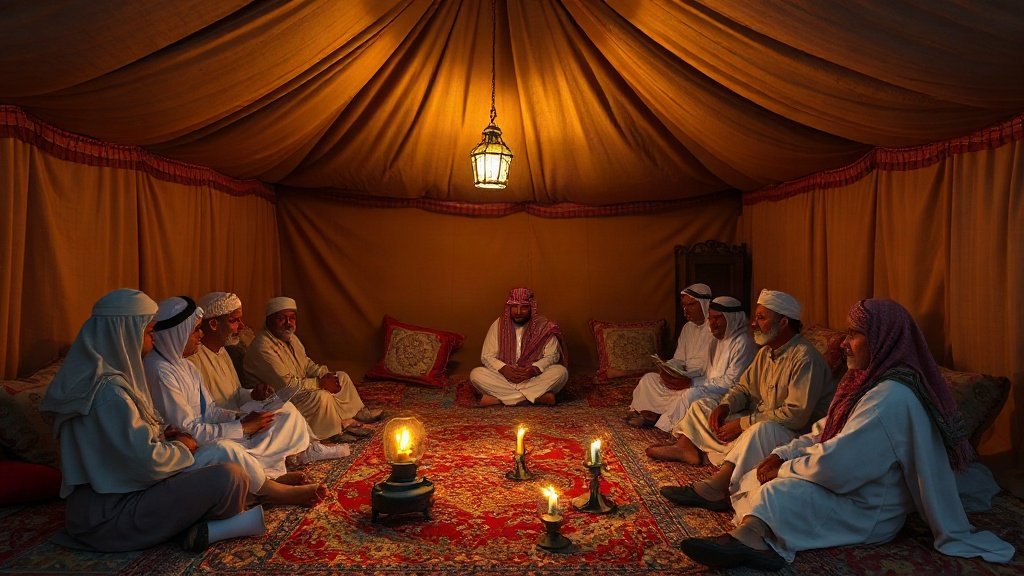
Illustration: AI-generated image
Across the Arabian Gulf, poetry is far more than a literary form; it is a living thread woven into daily life. Among its many expressions, Nabati poetry stands out as a rich vernacular tradition that has been passed down through generations of Bedouin and coastal communities. Often described as the people's poetry, it offers a direct window into the region's values, history and emotions.
Nabati differs from classical Arabic poetry in both language and style. It is composed in the local dialects of the Gulf, making it immediately accessible to ordinary listeners rather than only to the highly educated. The word 'Nabati' itself is thought to derive from the idea of something that springs naturally from the earth, reflecting its roots in oral tradition and the everyday speech of the desert. While classical poetry follows strict metres and an elevated vocabulary, Nabati allows for greater flexibility, though it still relies on rhythm, rhyme and a deep poetic structure.
The origins of Nabati poetry stretch back centuries, with early examples attributed to poets from the Arabian Peninsula, particularly from the Najd region and the area that is now the United Arab Emirates. It flourished among Bedouin tribes, who used it to record historical events, settle disputes, praise leaders, extol virtues such as courage and generosity, and express love, longing and grief. Camels, falcons, desert landscapes and the sea often appear as powerful symbols, anchoring the verse in the physical world of the Gulf.
Traditionally, Nabati poetry was performed orally in the majlis, the communal gathering space where men and women would share news, stories and verse. A skilled reciter could hold an audience for hours, using tone, gesture and rhythm to bring the words to life. Poetry duels, known as muraja'at or qilat, were common, in which two poets would exchange improvised verses in a test of wit and linguistic skill. These contests remain a beloved feature of cultural festivals today.
In modern times, Nabati poetry has found new platforms. Television programmes such as Sha'ir Al Million (Million's Poet) in the UAE and Prince of Poets have brought the art form to millions of viewers, turning talented reciters into household names. Social media has also allowed young poets to share their work widely, often blending traditional themes with contemporary concerns such as identity, urbanisation and social change. Despite these innovations, the core of Nabati poetry endures: a commitment to eloquence, emotional truth and the musical beauty of the Arabic language as spoken in the Gulf.
For visitors and residents alike, experiencing Nabati poetry offers a profound insight into Gulf culture. Whether at a heritage festival, a local poetry evening, or simply by listening to recordings, one can appreciate the artistry that has shaped the region's soul for generations. It is a tradition that celebrates memory, identity and the enduring power of the spoken word.